
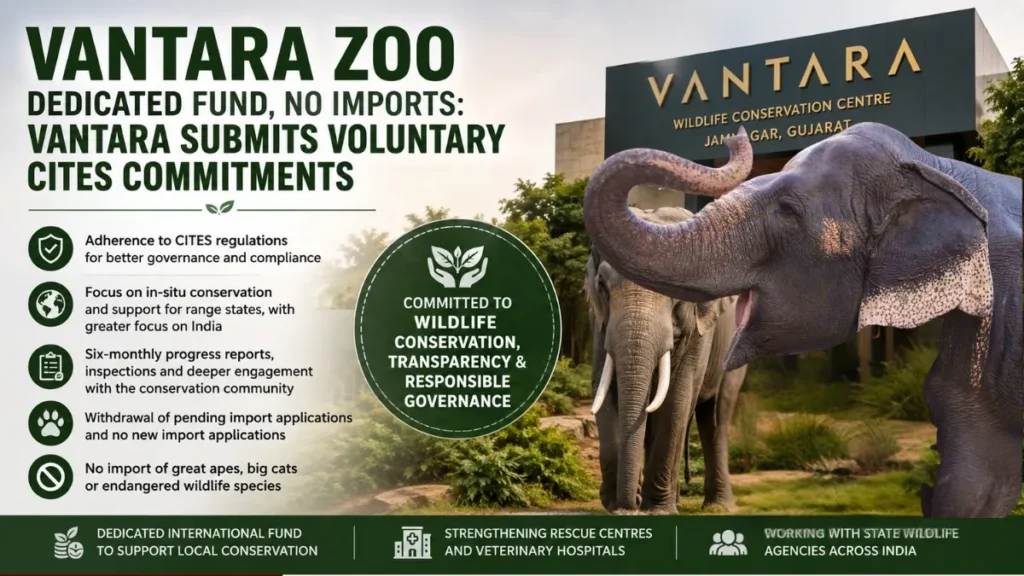
Vantara zoo, the wildlife rescue, rehabilitation and conservation centre in (Vantara Jamnagar) Gujarat, has submitted a series of voluntary commitments to the CITES Management Authority of India, outlining a stronger framework for transparency, conservation, governance and compliance.
The commitments were submitted on Wednesday to the CITES Management Authority and have also been placed before the Supreme Court as part of the broader compliance process. The move comes after Vantara’s Governing Council reviewed feedback, concerns, observations and suggestions raised over time by conservation organisations, experts and other stakeholders.
The new commitments place greater emphasis on compliance with the Convention on International Trade in Endangered Species of Wild Fauna and Flora, commonly known as CITES. The international agreement regulates the trade and movement of wildlife and plant species across borders to ensure that such activities do not put threatened species at greater risk.
Vantara Zoo to Focus More on Conservation in Natural Habitats
One of the major points highlighted in the commitments is Vantara’s decision to give greater priority to in-situ conservation, which means protecting and supporting wildlife in its natural habitat and within its native range.
As part of this approach, Vantara said it intends to expand its conservation focus in the countries and regions where wildlife naturally occurs. At the same time, the centre said India will receive increased attention as it strengthens its domestic conservation activities.
The organisation said its philosophy is based on the belief that every animal deserves care and protection. According to Vantara, this principle applies not only to the animals housed and treated at its Jamnagar campus but also to its efforts to provide expertise, resources and support for wildlife conservation in countries where species originate.
No New Import Applications for Animals
A significant part of the voluntary commitments relates to the international movement of animals.
Vantara said it will withdraw its pending applications seeking permission to import animals. It has also committed to submitting no new import applications. If circumstances require an import application in the future, the centre said it will first consult the CITES Management Authority of India.
The organisation further stated that any future animal imports would be limited to animals sourced from registered zoos.
Vantara has also made a specific commitment not to import great apes, big cats or endangered wildlife species. The decision marks a clear shift toward tighter controls over any potential international movement of animals associated with the centre.
Dedicated Fund for Wildlife Conservation
Another measure announced by Vantara is the creation of a dedicated international fund to support wildlife conservation efforts at the local level.
The centre said it plans to increase its work in rescue, rehabilitation and conservation within India while also supporting state wildlife authorities. Strengthening rescue facilities and veterinary hospitals has also been identified as part of its wider conservation efforts.
The focus is not limited to caring for rescued animals after they reach the Jamnagar facility. Vantara said it will also work to support conservation efforts in the places where wildlife naturally lives, including through cooperation and assistance to relevant conservation agencies.
Greater Transparency Through Regular Reports
Transparency is another key element of the commitments.
Vantara said it will submit progress reports to the CITES Management Authority every six months. The organisation has also said that it will invite the authority to conduct inspections of its facilities.
In addition, Vantara plans to increase its engagement with the wider conservation community. The move is intended to create greater interaction with experts, organisations and stakeholders working in wildlife protection and conservation.
The commitments come as Vantara seeks to strengthen its governance and compliance framework following discussions and feedback from different sections of the conservation community.
Also read: Vantara Foundation Proposes Three Wildlife Rescue and Rehabilitation Centres in Assam
Stronger Role in India’s Wildlife Conservation
Alongside its international commitments, Vantara said it will continue working on rescue, rehabilitation and conservation projects within India. Support for state wildlife agencies will form part of this effort.
The centre has positioned the new measures as part of a broader shift toward conservation-focused activities rather than concentrating solely on the care of animals at its Jamnagar campus.
With the new commitments, Vantara has outlined a model that combines wildlife rescue and rehabilitation with habitat-based conservation, support for government agencies, veterinary infrastructure and greater transparency.
The commitments submitted to the CITES Management Authority and filed with the Supreme Court now provide a framework for how Vantara intends to approach international wildlife-related activities going forward. Its decision to withdraw pending import applications, avoid new applications and rule out imports involving great apes, big cats and endangered wildlife species is among the most notable aspects of the announcement.
The organisation has also reiterated that conservation within India and support for wildlife in their natural range will receive greater attention. Through regular reporting, inspections and engagement with conservation stakeholders, Vantara said it intends to strengthen accountability while continuing its work in wildlife rescue, rehabilitation and conservation.